I Was “Lou Gehrig” Lucky – Growing Up Italian American in the 70’s

I couldn’t have been much more than seven, eight years old. It was another sparkling summer day in my grandparents’ yard, playing ball with my friends. We had makeshift bases to simulate a baseball diamond in that expansive space, and I was charging hard around them after a drive to the “outfield,” near the fence, heading for home plate.

Trying to score a run, I slid feet first into home, unaware of a rock protruding from the ground near the makeshift base. During the slide, the rock gashed the skin inches from my ankle bone.

From there, the memory of this sixty year old me is a little cloudy.

I don’t recall if the injury was serious enough to warrant medical attention, or just a quick tape job to stop the bleeding.

I saw my Zio Mariano (“Uncle Mario”) in the front yard, and hobbled over, calling out to him to check out my wound. The look of concern on his face said it all: this kid’s hurt!

I don’t remember any trips to the hospital that day, but his look of concern covered all the bases (pardon the pun): whether a small cut or something in need of stitches, it was Uncle Mario to the rescue.

And that’s the way it always was as I was growing up – no matter the trouble a younger me got into, I was sure an Italian immigrant would have my back.

Luckiest Man

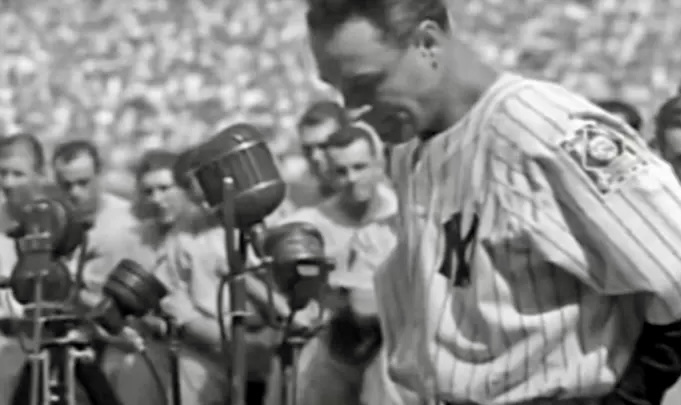
Most history buffs and baseball aficionados are familiar with the story of Lou Gehrig. A star first baseman for the Yankees – known as the “Iron Horse” for his 2,130 consecutive-games-played streak – he is perhaps most famous for the disease that bears his name: ALS, or amyotrophic lateral sclerosis.

Later to be known as “Lou Gehrig’s Disease.”

You may also remember grainy black and white film footage where he uttered these famous words at a home plate retirement ceremony at Yankee Stadium: “For the past two weeks you have been reading about (my) bad break. Yet today I consider myself the luckiest man on the face of the earth.”

He knew the possible ramifications of his illness, but faced it with an attitude of appreciation for all that life had given him.

A Lucky Childhood

Baseball was always a metaphor for the sun soaked days of my upbringing – whether it was playing ball with friends (and hopefully not hurting myself), slamming a rubber ball against the rear wall of my grandparents’ brick ranch for hours, or listening to a Yankee game with my grandfather while sipping espresso on the back patio – baseball came to symbolize several of the many facets of growing up surrounded by Italians.

My lucky streak was colored not just by my grandparents, and my rescuer Uncle Mario, but also by many others: my other great uncle Antonio, farm boy strong, capable of overturning a huge rototiller on his own.

My grandmother’s sisters, Carmela and Nicolina, the latter shaping a great deal of my later life.

The great uncle I never met, Dominick, killed in action during World War II, but always a living legend whose stories I heard frequently back in the day.

Lucky charms included not only being part of a tight knit family, but also growing up in a tight neighborhood.

You could do nothing on our street – and I mean nothing – without the ladies across the way, Katie Germano and Carm Muscatello, knowing about it and sharing the intel with the rest of us.

Little ol’ me, left, flanked by my parents. My grandparents, across the table, were never far away.

I was lucky to learn the importance of work ethic from them all. To be part of picnics with insane amounts of food.

Being able to sip homemade wine in my youth (cue Uncle Mario again!). Gleaning the value of not only work, but relationships and social connections that were rooted at the immigrant experience in our neighborhood.

Time may change me, but I can’t trace time

David Bowie

It’s a lucky streak that I’m not sure families, friends, and connections have now, especially growing up. Whether the obstacles be ever more intrusive technology, or a pandemic that nobody expected, the path can be different.

You might say I was just lucky to grow up when I did.

I drove down that street where I grew up just the other day, and my memories are colored by images that look much different. Various parts of that street are now in decay, my childhood home has graffiti on it, and the shrubs in front of my grandparents’ house have overgrown, now resembling trees.

Is “Lou Gehrig lucky” a bit of an overstatement? Probably. But, it’s all perception as to how you see your life and the fortunes you’ve been blessed or cursed with.

I’ve never stood at home plate in Yankee stadium, but I’ve slid into home plate on a long forgotten summer day in my own magical arena, surrounded by fruit trees and vegetable gardens, with an unparalleled support system looking on.

And that was always good enough for me.

Like this article? There are 145 more like it on this site. Browse around! It would be helpful if you could share on your favorite social media channel. For additional articles, see the related content below, and to be notified of future posts, please enter your email in the space provided.
Shoemaker’s Son: How Rocky Marciano Ignited Italian America

As a boy, I vaguely remember the older Italian men, inside and outside my circle, having discussions of famous athletes of the day, and their inspiring rise to fame.

No doubt you’ve heard of some of them.

Names like Berra, Williams, Rizzuto.

Mantle. DiMaggio.

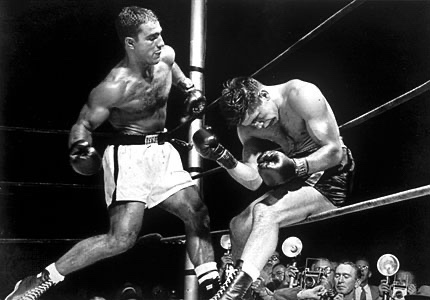
One that stands out in particular was Rocky Marciano. If the name sounds unfamiliar, he retired as the undefeated heavyweight boxing champion. I grew more curious as I heard the name Marciano in those influential circles.

To describe his rise to glory to that pinnacle as unlikely would be a kind assessment.

Unlikely to survive illness as an infant.

Unlikely to escape the factory life that consumed his father’s life.

Unlikely to become great in a brutally physical sport with his raw, limited skills.

With one sledgehammer of a right hand, the unlikely story no longer resembled a fairy tale, but the ignition of a suppressed culture and an inspiration to millions of immigrants looking for a ray of light, a shred of hope.

An American with Italian roots became heavyweight champion.

According to a piece by writer Al Bruno in La Gazzetta Italiana:

(Marciano) achieved the unthinkable and unimaginable to become boxing world champion. “Get out of this factory and be somebody important,” Marciano’s father, Pierino, a native of Abruzzo, would repeatedly urge and remind his oldest son: fueling him emotionally to do something “special” and rid himself of oppressive factory work and imminent poverty. Young Marciano feared poverty most for his parents and he wasn’t going to let that happen.

I often compared the physical and mental makeup of my grandfather, Sebastian, to Marciano: a short, compact frame, always moving forward, in a relentless space of grit and determination.

Like my grandfather, Marciano’s work ethic may have been the single determining factor in the successes of his life. According to Bruno, “Marciano was on a ‘no-lose’ mission to achieving greatness and he did so by simply out-working and out-conditioning all foes.”

Marciano, remarkably consistent and disciplined, spent hours in the gym, sparring, performing hundreds of push-ups and sit-ups, and putting at least seven miles of roadwork a day.

Similarly, Sebastian performed his jobs like a man possessed: as any true Calabrian would.

As Stanley Tucci described his Calabrese grandparents in his best seller, Taste“my grandparents left the extreme poverty of Calabria and… knew nothing but labor. All of that labor was dedicated to survival and creating a life with only the most minimal of creature comforts. Nothing went to waste, and luxuries were unheard of.”

Sebastian, as well as my Sicilian grandmother, went through a similar arduous journey.

I’m unsure if my grandfather was at all influenced by Marciano. He was a man of few words and many deeds. A true representative of the “old-school” way of thinking.

I do know that he, after finishing a shift at the factory, would quickly move to our family’s first restaurant, Jack’s in Troy: a bartending shift awaited, to occupy his night.

Was he, in fact, under a subtle influence of the Friday Night Fights of the day? Watching boxers struggle to the apex of the maximum fifteen rounds, as he fought through never ending hours of shift work?

I’d like to think that, in a quieter moment, he stood behind that bar capturing renewed inspiration, watching the athletic struggles of the small screen.

Marciano, against all odds, became heavyweight champion, igniting a culture into social prominence. Sebastian became the champion of his family, determined to leave the poverty of Calabria behind.

For me, and others in our family, he transformed himself from a poor Italian immigrant into the heavyweight of our times.

Like this article? Please share on your favorite social media channel. For additional articles, see the related content below. To be notified of future posts, please enter your email in the space provided.

Why I Love That Chip on Tom Brady’s Shoulder

Featured photo by amny.com

As a fan of the New York football Giants, my opinions of Tom Brady ran the gamut from mild distaste to unwavering suspicion (think: Deflategate).

Brady, even with his success, could be viewed (albeit rarely) as an unfortunate figure: with two crushing Super Bowl losses to New York, fueled by game saving Eli Manning passes that could be described as nothing less than miraculous (check out the freakishly accurate throw to Mario Manningham in Super Bowl XLVI).

Even with those two unlikely defeats, last week Brady secured his seventh Super Bowl win in 10 attempts. To label him the greatest of all time is making an understatement.

With his successes comes my growing admiration: even as a Giants fan, I recognize Brady’s humility and praise of his team’s efforts to buoy that success. Even better, he knows he’s an older guy that needs to work even harder to sustain the levels he’s reached.

Photo: foxnews.com

At 43 years old, he is the oldest quarterback to start a Super Bowl game.

That’s the reason I’m now fond of Brady: not much younger than myself, he lives and plays with a certain fire. Never satisfied, and still with a gigantic chip on his shoulder.

If you’re a man, in your 40s or 50s, and not inspired by Brady’s exploits, you should see your doctor and have your testosterone checked.

The chip on his shoulder, formed by being drafted out of college in the sixth round (even now, it sounds ridiculous), has never been worn down by the swells of his success. Even behind that smiling face and “aw, shucks” demeanor, you know his attitude is to burn the most competitive foe.

As someone that has experience with chip on shoulder syndrome, I can relate. The chip on me formed as a middle schooler, overweight and an easy target, and segued into a Stallone inspired workout regimen and steely resolve into fighting shape. That chip has never wavered, and into my late 50s, I still pursue the ideal of what will be the best physical shape of my life.

There is no other alternative than to go down fighting. With Brady, you can just sense his never quit mentality.

With as much as I hold my example close to heart, to be fair, it’s a small one. I have family, relatives who were crucial in setting the table of prosperity that we sit at now, to give the most credit.

Picture this: your father, a successful businessman, and your mother, a healer, pull you from your home because of outside criminal threats. Mayhem and violence.

You leave your home country, landing by boat to the bleak skies and bitter winds of New York City. We’re not in sunny Sicily anymore.

In your previous life, you had relative luxury – even with staff to help you keep house. In the new land, you are nothing: in some eyes, less than nothing. You now have nothing. The tables have turned. You are now the servants.

That’s how, as a child, my grandmother’s story started. The nucleus of my grandfather’s story isn’t vastly different. For them to survive – to hell with the concept of succeeding – they needed a chip the size of a boulder to plant on their already weary shoulders.

They had them. And they made it. Through sheer force of will, with the strength of their backs and resolve, they built lives, businesses, communities, and a deeply appreciative family.

To say my grandmother and grandfather were ferocious competitors in the game of life would be yet another understatement, on the same level of calling Brady a decent quarterback.

No matter what type of shit storm they had to persevere through – and there were plenty of them – they never stopped moving forward. They were, as I’ve often said, relentless.

Watching Brady meticulously call audibles and throw passes last Sunday, to keep a lightning fast Chiefs defense on its heels, I didn’t think of comparing future fortunes of two unrelated, underrated underdogs: whether a late blooming college player, or the immigrants that spent so many years working to shape our own destinations.

The conclusion I came to draw is undeniable: with the team I always had around me, I was set up to win big games my entire life.

Like this article? Please share on your favorite social media channel. For additional articles, see the related content below. To be notified of future posts, please enter your email in the space provided.

Joe Lied – And Why It Should Matter To You

Courtesy of Wikipedia

The legacy of Joe Paterno was of a football program that molded boys into men, and did so with success for many years. Paterno was the archetype of the term “college football coach”, and a model of the Italian American community.

In that community of sports figures, his name could have easily been mentioned in the same breath as Lombardi, DiMaggio, and Marciano. Legendary in his work.

How sickening it was to learn, this past week, that his legacy will have nothing to do with football – but will have everything to do with his role as a protector of a sexual predator. A predator that preyed on children, ruining their lives.

It was easy to think previously that Paterno knew nothing, or knew little, about the crimes of Jerry Sandusky. That they were beyond his comprehension. But he did know. He knew for years. Lied about it. Did his part to try to cover it up.

He turned his back on the innocent. All in the name of his football program and its “reputation”. He could have stopped the actions of a monster, but he turned his back instead.

Could this have happened under the watch of Lombardi? In the locker room of DiMaggio? In the gym of Marciano?

Before the information from the Penn State investigation came out last week, I would have said “no”. As in hell, no. But no can turn into “who knows?”. Now, you can never be sure. About anything. This is part of what Paterno’s betrayal has done.

The worship of men, no matter the status, is a losing proposition. Can’t do it. It gives power and prestige to those that should never have it. Because they are human. They are flawed. Some of them are evil.

How many parents do you think felt completely confident sending their boys into the Penn State football program? Answer: All of them. How could they have known that they were bringing their children to rapists, molesters, liars?

If you are a parent, you are always on the offensive to begin with. When your kid drives a car. When they get into a car driven by someone else. When they go out with a friend.

Parents, it’s time to get your paranoia on. If you haven’t already. Every time your kids meet a new friend, meet a friend’s family, or go out among strangers, question it. Question everything. Make them give you every bit of information their little brains have.

Go on the offensive.

You’re in a new world now. Where coaches protect criminals, and themselves, in the name of fame, power and money. God forbid if your child is the one in the crossfire.

I admired Joe Paterno. Thought he was one of the good guys, a role model. I was fooled. I won’t get fooled again. The tradition that is the worship of men can no longer continue. Mickey Mantle is a memory, Willie Mays has faded, and “Where have you gone?” is a question that is no longer asked of Joe DiMaggio.

We know where they have gone. What they’ve left behind is a world where human tragedies play out off the field in the business of sports.

Like this article? There’s more on the way! You can get free updates to content at this site by subscribing by email or feed reader. Feel free to share via Twitter and/or Facebook.

The Fall of an Italian American Icon: A Story Without Heroes

The death of former heavyweight champion “Smokin’ Joe” Frazier was enough bad news in the world of current events last week, another symbol of youth that fades away from all of us.

It doesn’t seem that long ago that I was a kid watching Frazier battle through his epic trilogy with Muhammad Ali, the epitome of a big heart and soul that went through life with his head down, at full speed.

He died of liver cancer last week, at the fairly young age of 67. He was tough, but eventually the fight ends for all of us.

He was a sporting figure worthy of your admiration, his resilience and tenacity being his greatest qualities. As an undefeated fighter, he took his championship into the ring against George Foreman, and was promptly knocked to the canvas six times en route to his first defeat in the brief bout.

But, Frazier kept getting up after each knockdown. He didn’t give up, and was only stopped by referee Arthur Mercante calling a halt to the bout.

Unfortunately, the Frazier story was overshadowed by the sexual abuse scandal at Penn State University. Legendary Nittany Lion coach Joe Paterno was fired from his position as head coach, as he seemed to not do enough to help bring to justice one of his assistants, a dirtball named Jerry Sandusky, who may have abused dozens of young boys.

Courtesy of Wikipedia

Paterno’s story is disconcerting because he built a program over 40 years of doing good and helping boys become men not just through football, but also solid principles of every day life.

That doesn’t matter now. Paterno could have used his significant power and influence to alert local police to a sexual deviant on his campus. He chose instead to relay it to the Athletic Director, who dismissively swept it under the rug. With no follow up on his part, Paterno looks like a willing accomplice.

That may not be fair, but it’s how it is in the court of public opinion. That’s life.

This is a story without heroes. It is an American tragedy, committed on her grounds of higher learning. No one tried to help the kids. From the University President, to the AD, assistant coaches, executive directors, all the way to the janitors that may have seen some of these despicable crimes. No one helped the children.

All they cared about was their positions and their paychecks. No one saved the kids.

The question is, how do they get away with it so many times? Like the scandal that plagued the Catholic Church before this, how are these perpetrators able to assault these children with such frequency?

I ask: Isn’t there one vigilante parent out there? Out of all the parents of these kids, isn’t there one defender of our youth? Shouldn’t the long arm of the law be the last thing these criminals have to worry about? Isn’t there one parent who would draw a six iron from his golf bag with the purpose of pulling a “Lee Trevino” on this guy? So he couldn’t hurt any more kids?

Joe Paterno is no longer one of the greatest college football coaches to ever walk a sideline. He has become a symbol.

Joe Paterno is an Italian American icon whose fall from grace will symbolize our country’s failure to always concern itself with the well being of our children. It’s sad that a man who probably did the right things most of his life, couldn’t pull the trigger to do the right thing one more time. To put a sexual predator behind bars. To help protect our kids.

Did you like this article? If so, don’t keep it from your friends! Share it, tweet it, and tell me what you think of today’s modern athlete in the comments section.